
Home / Blog / Your Complete Guide to Canada VISA, Canada PR and Canada Work Permit

Your Complete Guide to Canada VISA, Canada PR and Canada Work Permit
Your Complete Guide to Canada VISA, Canada PR and Canada Work Permit

Many people choose to relocate to Canada first. The nation has made it very clear that it wants skilled workers from all over the world, and it has created an immigration system that fulfills this commitment. Through 2027, the government hopes to add more than 500,000 new permanent residents annually. 

For Indians, moving to Canada is a logical choice. A sizable and well-established Indian population already resides there. Skilled professionals from South Asia are in high demand in the job market. The region's public safety standards, educational institutions, and healthcare system are unmatched anywhere in the globe.


Factor

Details

Yearly Immigration Target

500,000+ new permanent residents (2025 to 2027)

Healthcare

Universal, publicly funded system available to all PRs

Children's Schooling

Free public education for children of permanent residents

Road to Citizenship

Eligible after 3 years of physical presence as a PR

Safety

Consistently ranked among the top 10 safest countries globally

Skilled Worker Salary

CAD 60,000 to CAD 110,000 per year on average

What Is a Canadian VISA and What Are Your Options

A Canada VISA is the official permission you need from the Canadian government to enter and stay in the country. Issued by Immigration, Refugees and Citizenship Canada (IRCC), it can be temporary or it can be the start of your permanent life there. The type of Canada VISA you should apply for depends entirely on what you are trying to achieve.

Here is a clear look at all the main options:

Visa Type

Purpose

Duration

Leads to PR?

Visitor / Tourist Visa

Travel, family visits

Up to 6 months

No

Student Visa (Study Permit)

Studying at a DLI

Length of program

Yes, via PGWP

Work Permit

Working in Canada

1 to 3 years, renewable

Yes

Express Entry

Permanent immigration

Permanent (5-yr card)

This is the PR route

Family Sponsorship

Reuniting with PR or citizen

Permanent

Yes

Provincial Nominee Program

Province-driven skilled needs

Permanent

Yes

What Is a Canadian VISA and What Are Your Options

Canada PR: Your Gateway to Permanent Life in Canada

Canada PR or Permanent Residency provides the permanent residency status which permits individuals to work, study and live in all areas of Canada without any limitations on their choice of employer or work site. You have not yet become a citizen but you possess nearly all the same rights as citizens do. The public healthcare system and free education for your children and family sponsorship through your employment create the benefits that you can access.

The most common way to get Canada PR is through Express Entry which uses a points-based system to handle three federal immigration programs namely the Federal Skilled Worker Program and the Federal Skilled Trades Program and the Canadian Experience Class. The Comprehensive Ranking System (CRS) score you achieve decides whether you receive an invitation to apply.

Here is what you get when you hold Canada PR status:

        Live and work anywhere in Canada with no employer restrictions

        Full access to Canada's publicly funded healthcare system

        Free public school education for your children

        Eligible to apply for Canadian citizenship after 3 years

        Sponsor your spouse, children, and parents to join you

        Social benefits including employment insurance and pension plans

        Travel and return to Canada freely without a separate visa

        Full protection under the Canadian Charter of Rights and Freedoms


How the Canada PR Points System Works

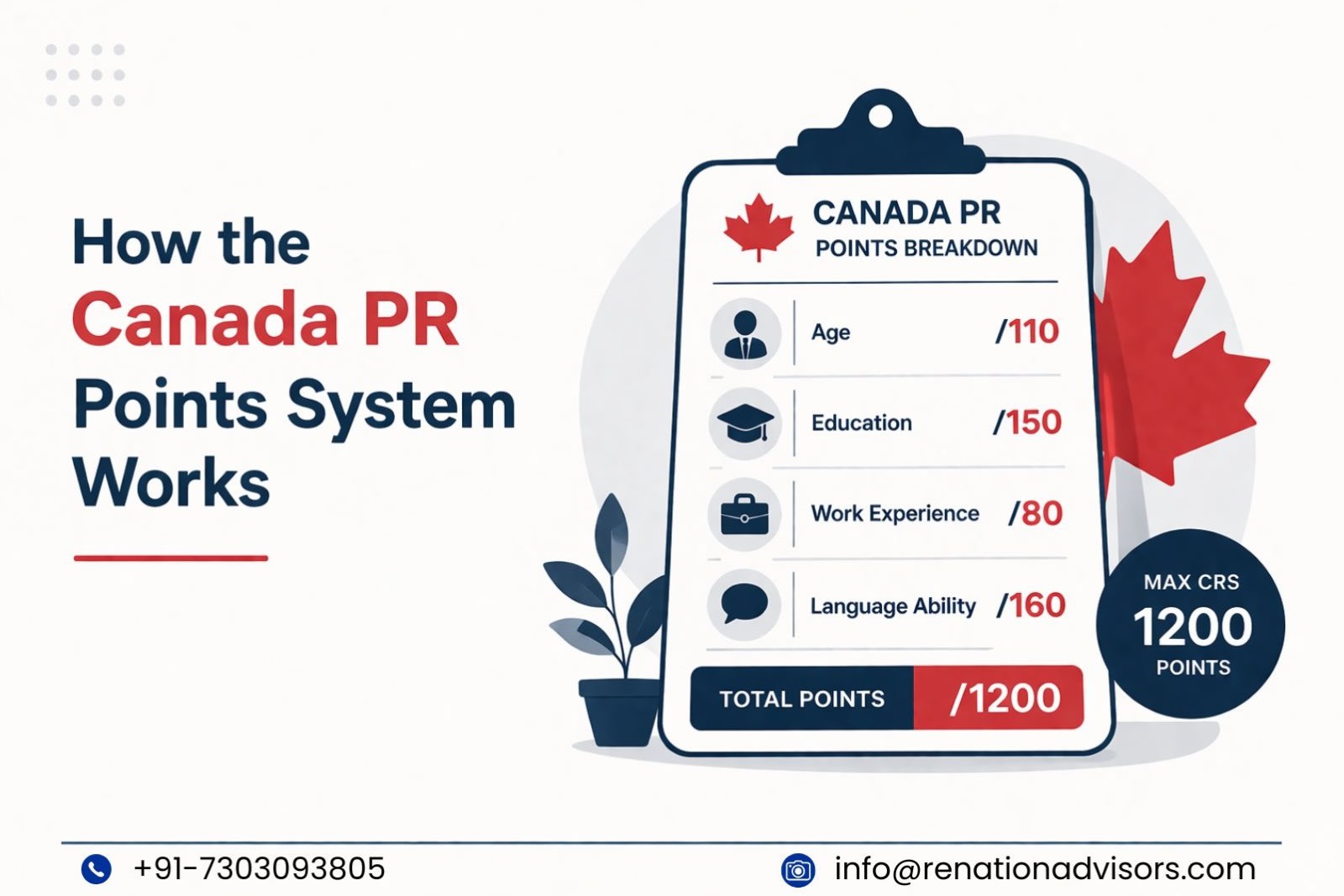
The CRS score is essentially your ranking within the Express Entry pool. The system can award up to 1,200 points, though the core human capital factors account for around 500 of those. Provincial nominations can add another 600, which is why getting nominated by a province can fast-track your Canada PR significantly.

CRS Factor

Max Points (Single)

Max Points (With Spouse)

Age

110

100

Education Level

150

140

Language Skills (English or French)

160

150

Canadian Work Experience

80

70

Valid Job Offer from Canadian Employer

200

200

Provincial Nomination

600

600

Sibling in Canada (PR or Citizen)

15

15


Recent Express Entry draws have had CRS cutoffs ranging from about 470 to 530 for general rounds. Occupation-specific draws for healthcare workers, tradespeople, and STEM professionals have sometimes gone as low as 430. Knowing your score and how to improve it is something our team at Renation Advisors specialises in.
How the Canada PR Points System Works

Understanding the Canada Work Permit

A Canada work permit lets you work legally in the country for a set period. For a lot of people, it is also a smart stepping stone toward permanent residency, because Canadian work experience directly boosts your CRS score and qualifies you for the Canadian Experience Class. The more time you work in Canada, the stronger your eventual Canada PR application becomes.

Permit Type

What It Means

LMIA Needed?

Employer-Specific (Closed) Permit

You can only work for the employer named on the permit

Usually yes

Open Work Permit

Work for any employer anywhere in Canada

No

Post-Graduation Work Permit (PGWP)

Issued to graduates of Canadian institutions

No

Intra-Company Transfer

Moved by your current employer to a Canadian office

Exempt

International Experience Canada (IEC)

For young applicants under bilateral agreements

No

Temporary Foreign Worker Program (TFWP)

Employer-driven, tied to a Labour Market Impact Assessment

Yes

The open Canada work permit is by far the most flexible option since you are not tied to a single employer. Spouses of eligible workers and graduates from Canadian universities often qualify for one too, which means your whole household can be earning income from the moment you arrive.

Step-by-Step: How to Apply for Canada PR Through Express Entry

The process has clear stages, but each one needs to be handled correctly. A mistake at any step can cost you time or even your application entirely.

Step

Action Required

Typical Timeframe

1. Assess Your Eligibility

Review your education, work history, and language scores

1 to 2 weeks

2. Take Language Tests

Complete IELTS or CELPIP (French: TEF or TCF)

2 to 4 weeks

3. Get Your ECA Done

Have your foreign degree assessed by a designated body

4 to 8 weeks

4. Create an Express Entry Profile

Submit your profile to the IRCC candidate pool

About 1 week

5. Wait for an ITA

Receive your Invitation to Apply during a draw

Weeks to months

6. Submit Your PR Application

File the complete application within the deadline

60 to 90 days after ITA

7. Medical Exam and Biometrics

Visit an approved physician and submit biometrics

2 to 4 weeks

8. Receive Your COPR

Confirmation of Permanent Residence issued by IRCC

6 to 12 months total

Eligibility Requirements: Canada PR and Canada Work Permit Compared

There is sometimes confusion about what IRCC expects for a Canada work permit versus a permanent residency application. Here is a side-by-side look:


Criteria

Canada Work Permit

Canada PR via Express Entry

Age

18 and above

18 to 44 gives the highest points

Education

Depends on the job role

Minimum secondary, higher preferred

Language (IELTS)

CLB 5 for most roles

CLB 7 minimum for FSWP

Work Experience

A job offer from a Canadian employer is usually needed

At least 1 year of continuous skilled work

Job Offer

Required for a closed permit

Not mandatory but adds 50 to 200 CRS points

Settlement Funds

Not needed if you have a job offer

CAD 13,310 minimum for a single applicant (2025)

Police Clearance

Sometimes required

Always required

Medical Exam

Required

Required

Canada PR vs Canada VISA: Key Differences You Must Know

A lot of first-time applicants assume that getting a Canada VISA and getting permanent residency are similar things. They are not. The difference in what each status allows you to do is significant, especially if you are planning to build a long-term life there.

Feature

Canada VISA (Temporary)

Canada PR

How Long It Lasts

Fixed period, weeks to a few years

Indefinite, renewed every 5 years

Work Rights

Restricted to what is on your permit

Work anywhere, for anyone in Canada

Healthcare

You need private insurance

Full access to Canada's public healthcare

Children's Education

Often involves fees

Free public schooling for your kids

Path to Citizenship

No direct route

Apply after 3 years of physical presence

Social Benefits

Minimal or none

CPP, employment insurance, child benefits

Sponsoring Family

Depends on your permit type

You can sponsor your spouse, kids, and parents

Top In-Demand Jobs in Canada for Immigrants in 2026

One genuinely exciting thing about moving to Canada right now is how actively the job market is looking for internationally trained professionals. Some sectors are running so short of workers that they have been given dedicated Express Entry draws with lower CRS cutoffs. If you work in any of these fields, your immigration prospects are stronger than ever.


Sector

Roles in Demand

Average Salary Range (CAD)

Healthcare

Registered Nurses, Physicians, Pharmacists

CAD 70,000 to CAD 180,000

Technology

Software Engineers, Data Analysts, Cloud Architects

CAD 85,000 to CAD 140,000

Skilled Trades

Electricians, Plumbers, Welders

CAD 55,000 to CAD 90,000

Finance

Accountants, Financial Analysts

CAD 65,000 to CAD 110,000

Construction

Project Managers, Civil Engineers

CAD 70,000 to CAD 115,000

Education

School Teachers, Early Childhood Educators

CAD 50,000 to CAD 80,000

Common Mistakes to Avoid When Applying

After working with hundreds of applicants, our consultants have seen the same errors come up again and again. Most of them are completely avoidable with the right guidance.

        Using the wrong NOC code for your occupation in your Express Entry profile

        Submitting an application with expired IELTS scores (they are only valid for 2 years)

        Not having enough settlement funds to meet the Canada PR minimum requirement

        Failing to disclose previous visa refusals from any country, including your own

        Missing the 90-day window to submit a complete application after receiving an ITA

        Applying for the wrong type of Canada work permit given your job offer situation

        Having inconsistencies between your employment letters, tax documents, and profile


Conclusion

At Renation Advisors, we do not take a templated approach to immigration. Every person who walks in has a different work history, different educational background, and different goals. Our job is to sit with you, understand your situation honestly, and build the right strategy for your move to Canada.

We help you from the very first eligibility check all the way through to your landing in Canada. That covers building your Express Entry profile, preparing your Canada VISA documents, handling Canada work permit submissions including LMIA-based cases, and making sure every piece of your Canada PR application is accurate and complete before it reaches IRCC.

If you are serious about making the move, get in touch with us for a free consultation. We will tell you exactly where you stand and what your best path forward looks like.


Tags: canada visacanada prwork permitexpress entryimmigration

Leave a Comment

Your email address will not be published. Required fields are marked *